

The Gap Between AI and Markdown Workflows
Most Markdown workflows today are simple and efficient. You write in your editor, organize content using headings, and maintain your files as plain text. This approach works well because it is lightweight and flexible.
However, integrating AI into the workflow can disrupt this efficiency.
Switching between your Markdown editor and an AI tool to paste content and retrieve suggestions interrupts focus and limits the AI’s effectiveness.
More importantly, the AI only accesses fragments of your work and lacks understanding of the full document or workspace.
What MCP Changes
Model Context Protocol addresses this issue by enabling AI agents to connect directly to external tools and environments.
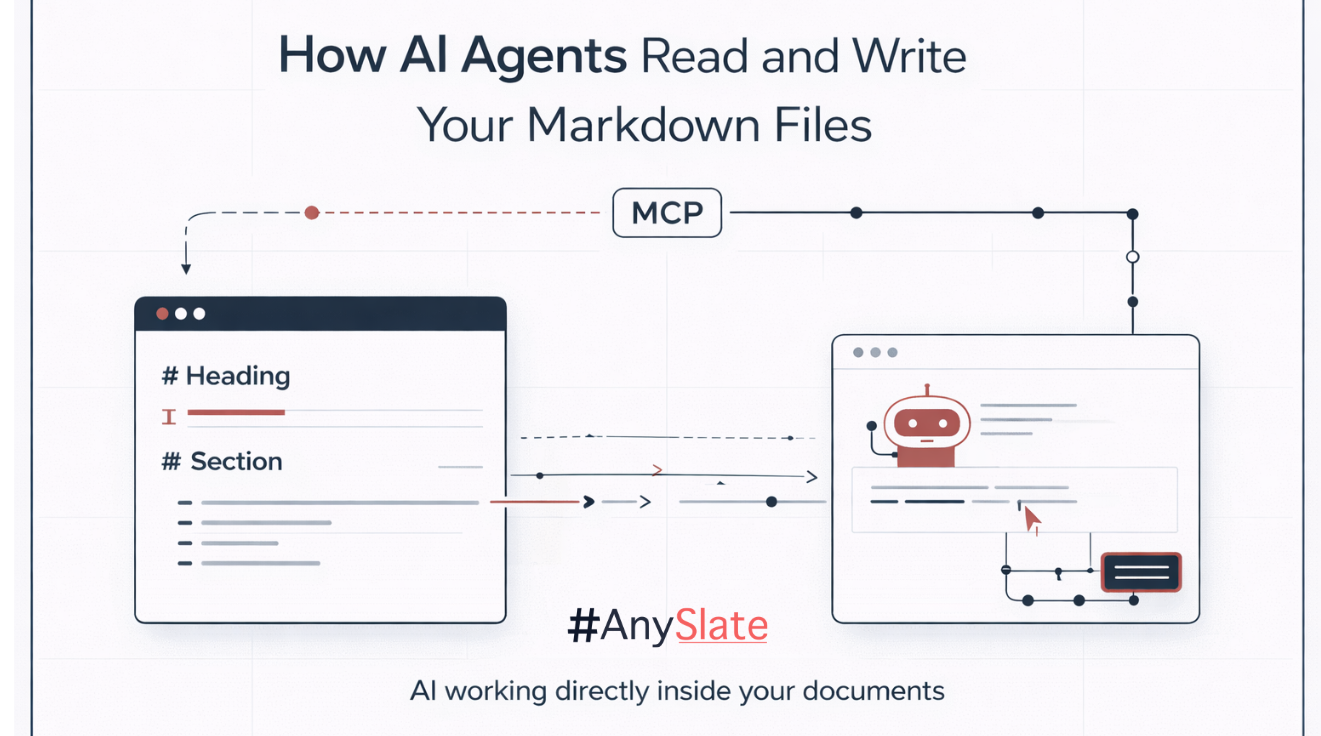
Rather than relying on pasted input, an AI agent can access Markdown files through a structured connection, allowing it to read documents, understand their hierarchy, and interact with them in context.
This shift transforms AI from a passive assistant to an active participant in your workflow.
For the first time, AI agents can work directly with your files, not just your prompts.
How AI Agents Read Markdown Files
With MCP, AI agents treat Markdown files as structured documents rather than plain-text blocks.
Markdown’s hierarchy of headings, lists, and sections makes it easier for AI to interpret content. The agent can identify sections, understand topic relationships, and process the document as a whole.
Instead of analysing isolated paragraphs, the AI can review the entire file and understand how sections connect. This results in more accurate summaries, better suggestions, and more relevant outputs.
For example, an AI agent can review a complete document and generate a structured summary without losing context. It can identify gaps, suggest improvements, or reorganise content based on the overall structure.
How AI Agents Write and Update Markdown Files
Reading files is only part of the workflow. The real value emerges when AI agents can also write and update Markdown files directly.
With MCP integration, AI agents can create new documents, edit existing ones, and refine content in place. They can restructure sections, improve clarity, and maintain consistency across multiple files.
For teams managing documentation, this saves significant time. Instead of manually editing each section, you can rely on AI to handle repetitive tasks while focusing on higher-level work.
Because AI understands Markdown syntax, it can make changes without disrupting formatting. Headings remain intact, sections stay organized, and the document maintains a logical flow.
The Role of AI-Native Markdown Editors
To fully benefit, your writing environment must support this capability. Not all editors are designed for this level of AI integration.
An AI-native Markdown editor is built specifically to work with AI agents. It enables seamless interaction between your documents and the AI system, eliminating the need to switch between tools.
Platforms like AnySlate are moving in this direction. By supporting MCP and prioritizing Markdown, they allow AI agents to operate directly within the workspace.
This creates a more natural experience, with writing and AI assistance occurring in the same environment.
Connecting AI Agents to Your Markdown Workspace
Setting up this workflow typically involves connecting your AI agent to your Markdown workspace using MCP.
Once connected, the AI can access your files and begin interacting with them, including reading documents, generating summaries, suggesting edits, and creating new content.
Tools like Claude or Cursor can be configured to work with Markdown workspaces, enabling a more integrated workflow.
Instead of viewing AI as a separate tool, it becomes part of your environment, working alongside you as you write.
Why This Matters for Teams
For individual users, this integration makes writing faster and more efficient. For teams, the impact is even more significant. more consistently. AI agents can help ensure that content is clear, structured, and up to date. Large knowledge bases become easier to manage because the AI can work across multiple files.
This reduces the effort needed to keep documentation useful and relevant over time.
As teams grow, this support becomes essential.
The Future of Markdown and AI
Tcombination of Markdown and AI agents marks a shift in the evolution of writing tools. Markofferhe down s a simple, structured format, while AI adds intelligence and automation.
MCP connects these elements, enabling them to work together seamlessly.
As more tools adopt this approach, expectations will shift. Users will no longer accept workflows that require constant copying and pasting, and will expect AI to interact directly with their documents.
Final Thoughts
AI agents are becoming more capable, but their true value depends on how well they integrate with the tools we use daily.
For Markdown users, MCP enables a more efficient and connected workflow. It allows AI to read, write, and improve documents without disrupting your process.
The result is a writing experience that is less fragmented and more collaborative.
As this approach becomes more common, AI-native Markdown editors will likely define the next generation of writing tools.