

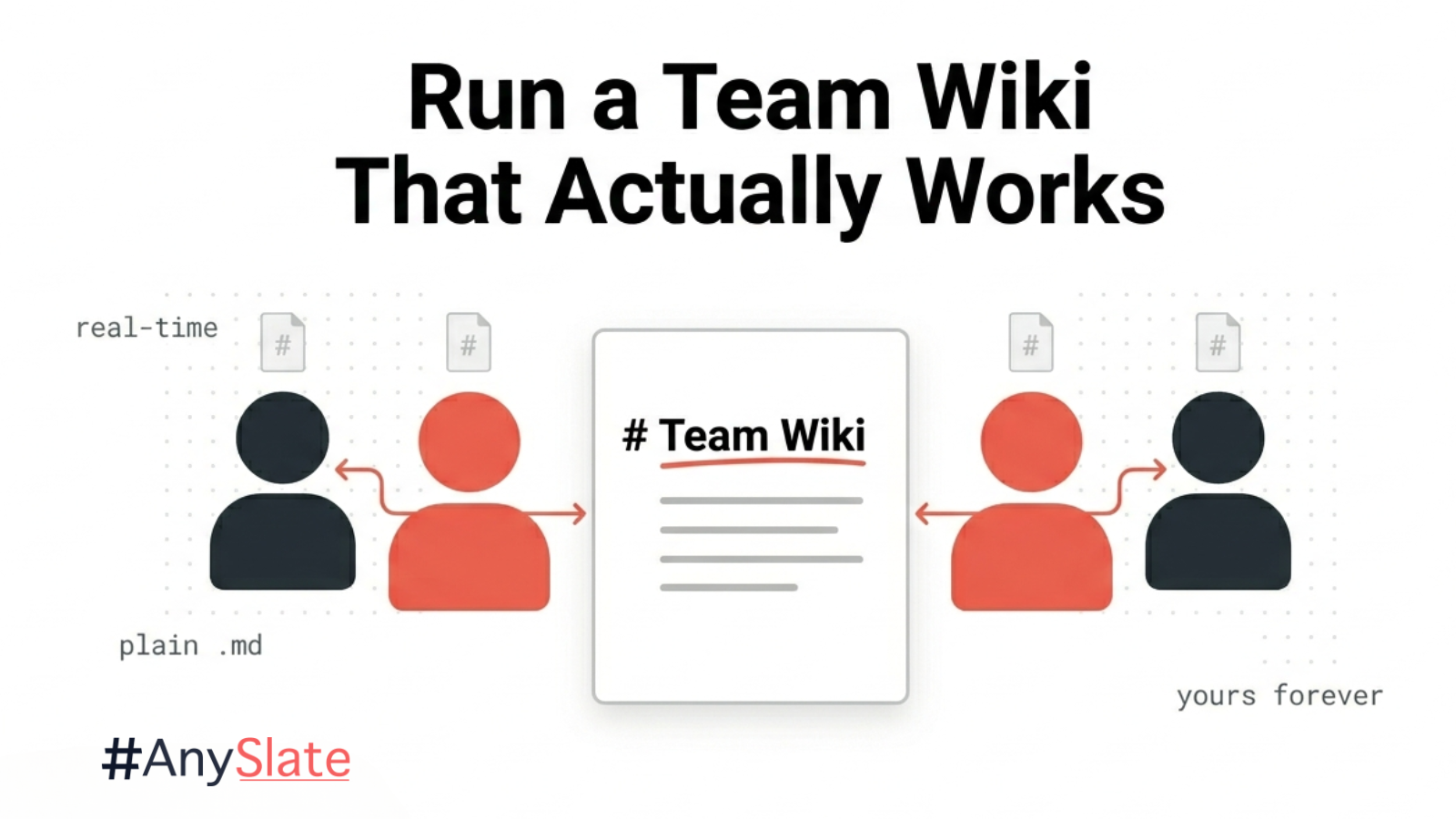
Why Wikis Die in Six Weeks
The collapse is always the same. Week one: the wiki is set up, a few pages written, and the structure looks clean. Week three: a deadline hits, and decisions start living in Slack. Week six: the wiki is out of date, and nobody trusts it.
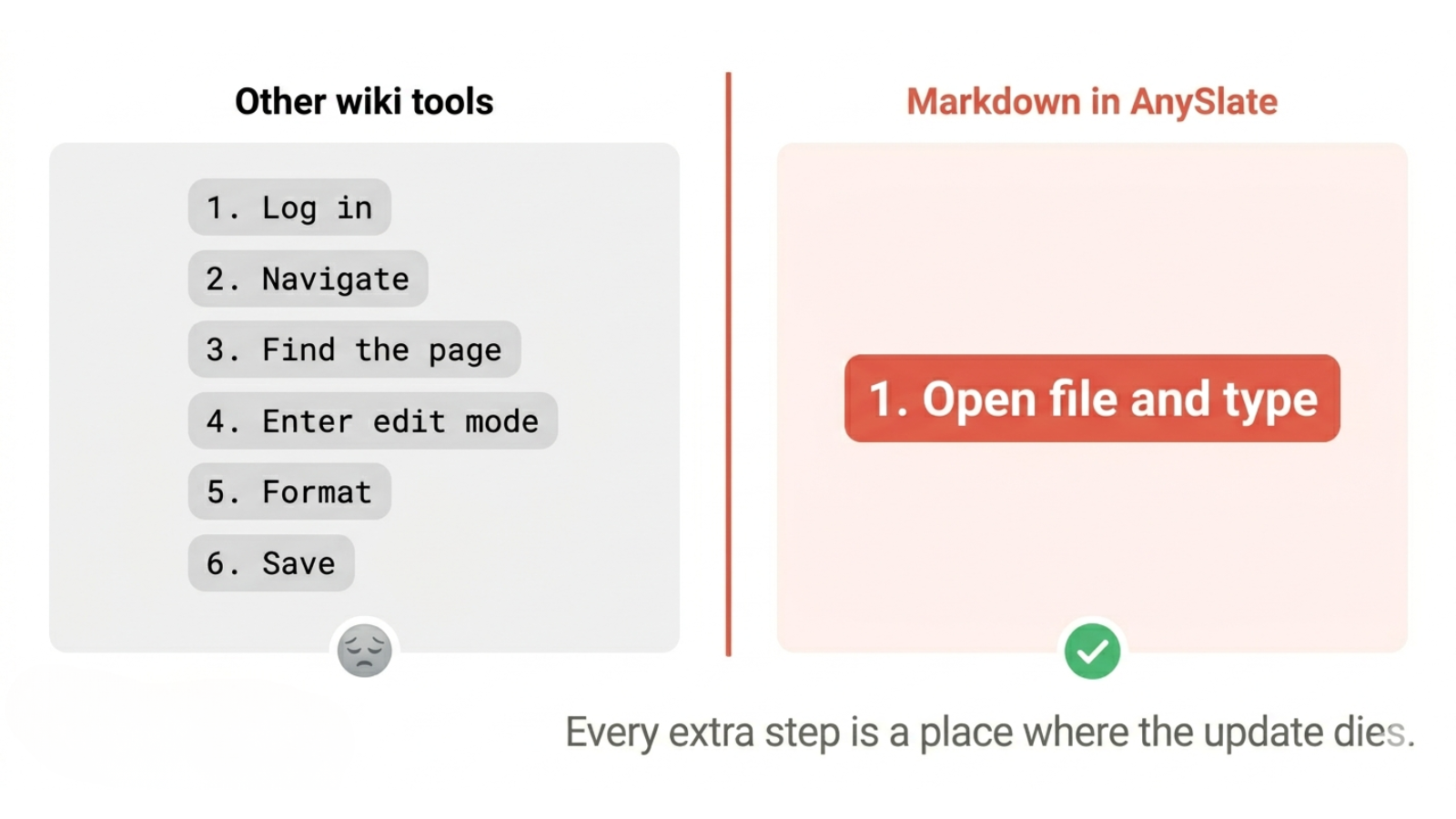
The root cause is the distance between where knowledge lives, in someone's head during a call and the number of steps it takes to get it into the wiki. Every extra step is a place where the update dies. Most tools have six steps. Markdown has one: open a file and type.
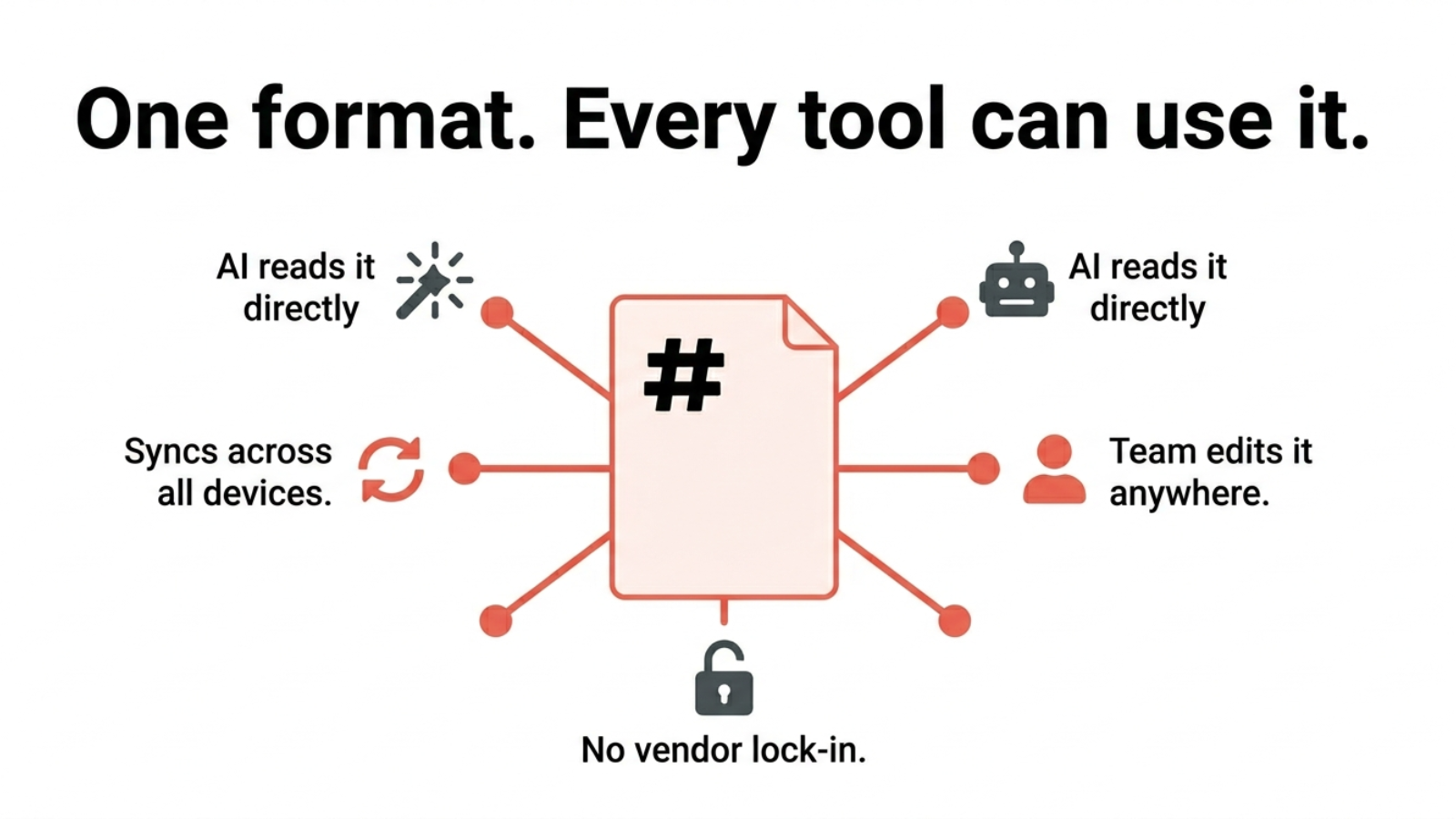
AnySlate makes that even faster. Documents sync instantly across Mac, Windows, Linux, and browsers, so contributing never depends on who is at which machine, or whether they remember the login.
The best documentation system is not the most powerful one. It is the one with the fewest steps between knowing something and writing it down. Every extra click is a place where the update dies.
The Folder Structure That Does Not Collapse
Deep folder structures optimise for storage, not retrieval. The teams with the most useful wikis do not have the most organised ones; they have the most findable ones. Five flat folders beat ten nested ones every time:
Folder | What lives here | The rule |
/ start-here | Onboarding, team norms, how decisions get made | If a new hire needs it in week one, it goes here |
/ projects | One file per active project — status, decisions, context | One project, one file. No subfolders. |
/ how-we-do-things | Processes, playbooks, repeatable guides | If you have explained it twice, write it once here |
/ decisions | Why we chose X over Y — reasoning, not just outcome | The why matters more than the what |
/ graveyard | Inactive projects, anything older than six months | Never delete. Archive. Context lives in old decisions. |
In AnySlate, this structure lives as cloud-synced .md files, searchable, editable from any device, in a format you own completely. No proprietary encoding. No export step. The files are yours.
Three Rules That Keep It Alive
Write before you close the tab. The best time to document a decision is immediately after the meeting, not tomorrow, not when you have time. Four hours later, three people remember it differently.
One document, one question. Write that question as the H1. A page that tries to answer two questions answers neither well. When it sprawls, split it; do not expand the folder structure to compensate.
Treat a stale link like a broken test. Assign someone monthly to review the ten most-linked pages and flag any outdated content. Fifteen minutes separates a wiki that compounds in value from one that becomes an archaeological site.
A team wiki is not a knowledge base. It is a living contract between the people who built something and the people who will maintain it. Write it as someone's clarity depends on it, because six months from now, at 11pm, it will.
Your Wiki Is Now an Input to Your AI Tools
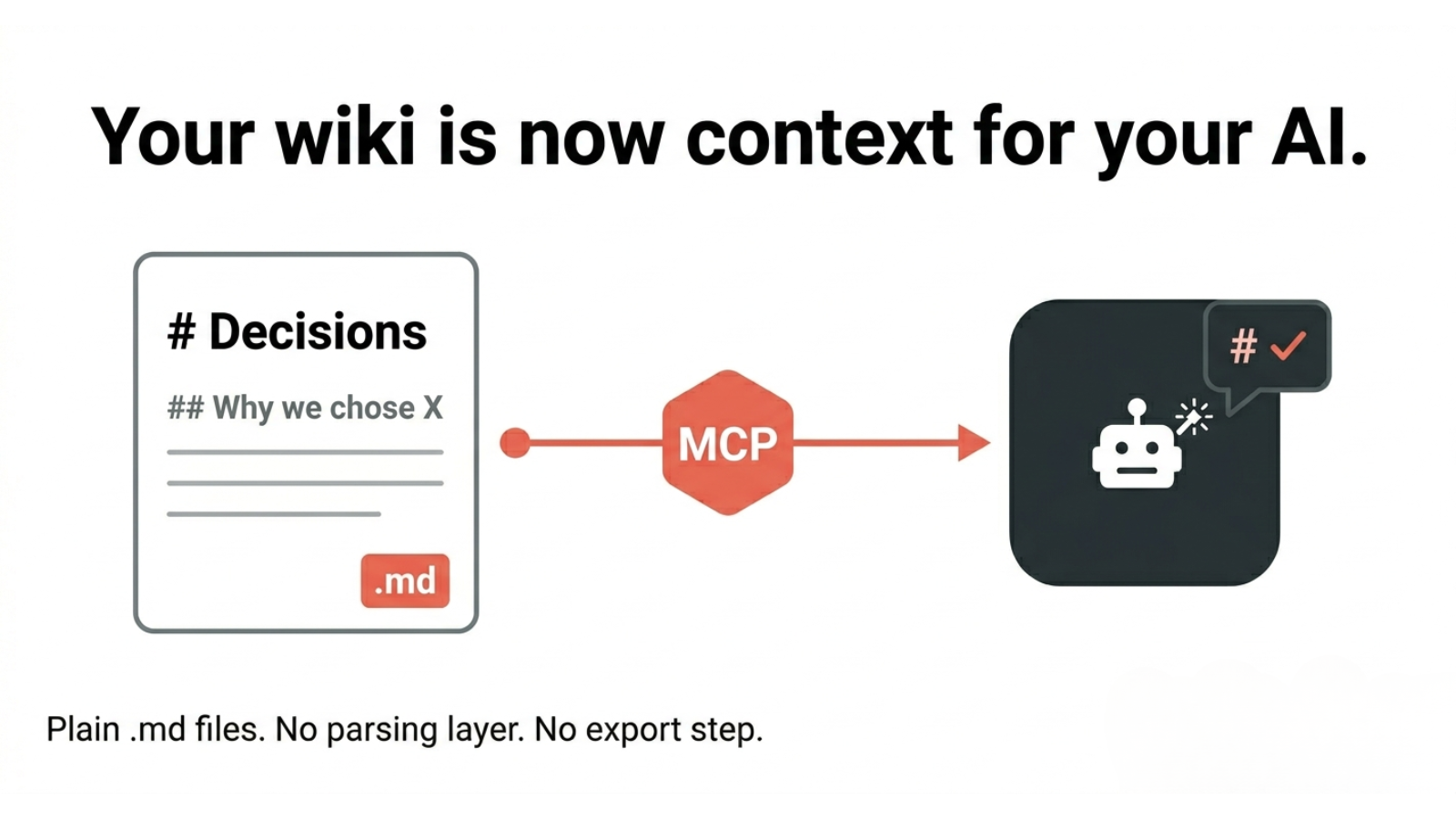
Plain-text Markdown is the most machine-readable prose format. An AI agent reads your .md wiki file the same way it reads your codebase, no parsing layer, no export, no proprietary encoding to decode.
AnySlate's native MCP integration makes this direct. Connect AnySlate to your AI tools, and the agent reads, searches, and writes to your documentation workspace without leaving the editor. A decision doc becomes a live context for architectural suggestions. A process doc becomes something an agent can execute against. The wiki stops being a static archive and becomes a working part of the team's operations.
The One Thing to Take Away
The teams with great wikis made contributing easier than not contributing at all. Markdown removes the formatting tax. A flat structure removes navigation friction. The three rules remove the ambiguity of what to write and when. AnySlate ties it together, with real-time collaboration, cloud sync, plain .md files, and MCP integration, so AI tools can read everything the team writes.
Your next decision is going somewhere. It can go into a Slack thread that disappears in thirty days, or into a plain-text file your whole team and their AI tools can find and trust a year from now.
Start at anyslate.io. Free plan available, no account needed for the desktop app.